I Know You Hear Me but Are You Listening Meme
Nosotros have three.5 million users.
That's 3.5 meg people who accept opinions about Jotform. People who can give us invaluable feedback on what features to build, updates to push button, and pages to redesign.

Merely merely if we know how to listen to them.
This is easier said than done. As Ralph G. Nichols and Leonard A. Stevens wrote in a Harvard Business Review article:
"People in full general do not know how to mind.
They have ears that hear very well, just seldom accept they caused the necessary aural skills which allow those ears to exist used effectively for what is chosen listening ."
Hearing and listening are not the aforementioned.
Different just hearing, listening requires us to interpret and empathize what is being said.
We need to know not only what words somebody has said, but what they meant by them.
Listening requires more than attention. Information technology as well requires humility if you lot're listening to criticism.
It's like shooting fish in a barrel to dismiss "haters" or "trolls" who talk negatively about your business, only tuning out opposing viewpoints doesn't make them go abroad.
There is always something to acquire from the perspectives of people we disagree with.
In his 2013 Ted Talk, Intel's Tony Salvador explains how, when we want to create a production, everything nosotros hear is "through the lens of the product we actually want to build."
We hear their feedback, but we don't actually mind to what they're proverb.
Salvador describes how companies choose not to focus on negative feedback and so release a product anyway. He explains what happens side by side:
"It doesn't sell and we're surprised because we actually got good customer feedback. Not really a skilful program.
A better fashion is to effigy out how to actually listen amend."
Across 12 years of building Jotform, we've had some hard lessons that taught us how to properly handle feedback.
Earlier I explain how to improve your effective listening, I want to share a few real life examples of how we listen to our 3.5 meg users, not simply hear them:
1. Listening to your customers while releasing new features
Final yr, we spent 326 days on a massive product release, aka Jotform Cards.
Every time we work on such a big launch, we continue the big reveal nether wraps, but we prove our new production or version to a pocket-sized exam group.
We start with 1% of our user base of operations and gradually build to 10%.
This system helps us to gather constructive feedback, root out problems, and compare the new version to previous iterations (if you have them).
Independent testing is essential — and it's the best way to polish your release past listening to a modest percentage of your users effectively without risking to frustrate all of them.
2. Interpreting why a customer actually wants to go out
Information technology's always disappointing when somebody cancels a subscription for your product. Withal, you can gain valuable insights when this happens.
When customers cancel their subscriptions, we ask them why they cancel and collect their feedback through a simple form. We and then endeavor to understand and interpret their feedback.

In many cases, they are leaving due to an issue we tin hands resolve. In these circumstances, nosotros contact the user directly via email and are able to get them dorsum.
Yous shouldn't wait until they are about to abolish, though.
I've recently explained why customer service is the new marketing which is exactly why our customer support team goes beyond handling open tickets.
For case, if a user mentions a new feature asking in a support thread, our customer agent takes intendance of bridging the innovation betwixt the customer and respective development team.
On the other hand, our marketing and UX teams continuously conduct interviews with users, collect text feedback, and video record them to create case studies.
3) Listening by showing upcoming feature requests
No thing how effectively we heed, chances are in that location will always be a few users unhappy with the new version or a feature release.
This is one of the reasons why, once nosotros release a new version, we endeavour to give our users the power to utilise the older version.
In improver, we're now developing a new component to show them our upcoming features. This is where nosotros'll display mockups of new features and enquire users whether they would like this new feature.
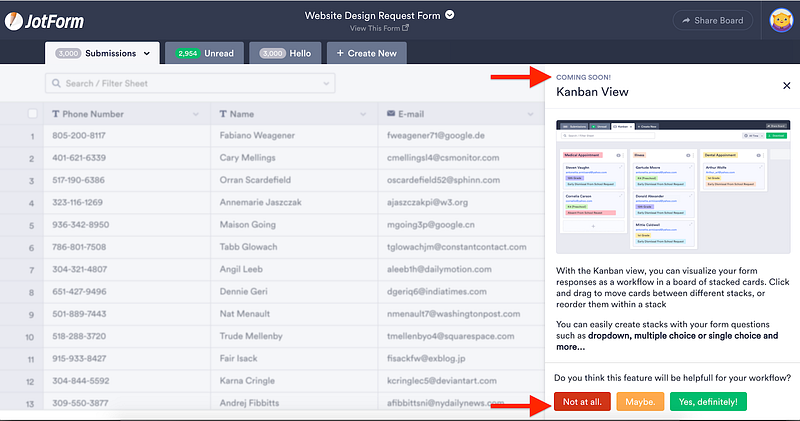
We desire feedback from users regarding planned features so we don't waste time creating something they don't want.
It's non almost guessing what users want.
It'southward about effective listening.
Now that I've shared some examples applied to business organisation, I'd similar to explain in detail the importance of effective listening and how nosotros can improve information technology both in real life and our businesses.
What is constructive listening?
Effective listening means y'all've fully absorbed what the speaker has said and fabricated them experience understood.
In a study that analyzed the listening skills of hundreds of businessmen and students, the results were disappointing.
Immediately after "listening," participants simply remembered about l% of what they had heard.
Half a year later, it dropped to 25%.
Oftentimes when we hear someone speak, nosotros're mostly focusing on how to respond when they're finished. According a Farnham Street article,
"Listening is difficult considering it involves suppressing your ego long enough to consider what is existence said earlier you answer."
So how practice we suppress our egos and go from but hearing to active listening? Permit's first with what not to exercise.
What to avoid when listening
- Don't overuse of the word "I." Author Tom Shachtman wrote, "The most frequently used written discussion in the language is 'the,' merely the most frequently spoken word…is 'I.'" Keep the focus on the person speaking and don't shift information technology onto yourself.
- Don't interrupt. Put your ego bated and don't assume yous know what a person is going to say. Interrupting sends the message, "My words are more than accurate or interesting than yours." Every bit lyrics past The Dynamos state, "The sound of our voices keep us from listening … We never intend to hear what each other say."
- Don't multitask. Every bit psychiatrist Yard. Scott Peck explains, "You cannot truly listen to anyone and exercise annihilation else at the same time." If you're speaking in person, make centre contact. If you're chatting or interviewing users online, focus on your response — non something happening in the room.
- Don't be silent. Conversations are meant to go both directions. When the person has finished speaking, information technology's natural to respond. You might say "It sounds like…" or "I've noticed that…"

How to be an constructive listener
- Practice enquire questions. Asking questions shows you understood what a person said as well as that yous care to learn more. Try sentences similar "Do yous hateful…?" or "Actually?"
- Do exist empathetic. Try to understand how a person feels virtually what they are telling you lot. Ask them questions about their emotions. Sometimes, people just want their feelings best-selling. Make a safety infinite where they feel comfortable sharing. Call back it'south well-nigh their emotions — not yours.
- Do stay on topic. We've all had conversations where we desperately desire to talk about something, simply are disappointed when the conversation goes another direction. If you accidentally pb a conversation away from the speaker'south intended topic, help to steer information technology back on track.
- Exercise make suggestions. This is a catchy one. Harvard analyzed information of participants in a program created to help managers amend their coaching skills. They discovered that those ranked as the virtually effective listeners tended to make suggestions. Only make certain you've checked all the other boxes earlier trying this one.
Moving Forwards
The truth is, nosotros all could ameliorate our listening skills specially when it comes to properly using feedback to improve our production.
Our hearing has evolved to ignore almost sounds, unless something seems dangerous. If we tried to hear everything in our surrounding environment, we would exist hopelessly overwhelmed.
We need to railroad train ourselves to focus our attention on people talking to us. We're constantly looking at means to gain feedback as well as requite our users easy ways to seek information technology as well.
But it's difficult.
We demand to ask questions, be empathetic, and requite suggestions.
Most chiefly, we demand to focus our attention completely on some other person, even if what they are maxim is difficult to hear.
In summary, using Author Dean Jackson's words:
"Listening is an art that requires attention over talent, spirit over ego, others over self."
This article is originally published on Jun 11, 2018, and updated on Aug 18, 2020.
Source: https://www.jotform.com/blog/active-listening/
0 Response to "I Know You Hear Me but Are You Listening Meme"
Post a Comment