A Baby With an Atrial Septal Defect Has a Hole Inbthe Interatrial
Atrial septal defect (ASD) is a heart defect that is present at nascence (built).
As a baby develops in the womb, a wall (septum) forms that divides the upper chamber into a left and right atrium. When this wall does not form correctly, it tin upshot in a defect that remains after nascency. This is chosen an atrial septal defect, or ASD.
Usually, blood cannot menses betwixt the two upper center chambers. However, an ASD allows this to happen.
When blood flows between the two centre chambers, this is chosen a shunt. Blood about often flows from the left to the right side. When this happens the right side of the heart enlarges. Over time pressure level in the lungs may build up. When this happens, the blood flowing through the defect will so go from right to left. If this occurs, in that location will exist less oxygen in the blood that goes to the body.
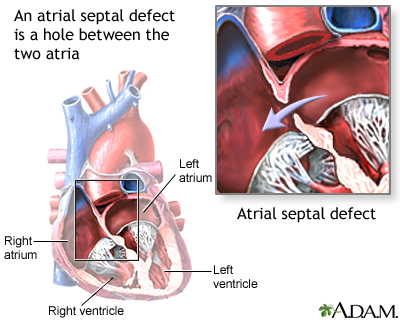
Atrial septal defects are defined as primum or secundum.
- The primum defects are linked to other heart defects of the ventricular septum and mitral valve.
- Secundum defects can be a unmarried, small or large hole. They may likewise be more than i small-scale hole in the septum or wall betwixt the two chambers.
Very small defects (less than 5 millimeters or ¼ inch) are less likely to cause problems. Smaller defects are frequently discovered much subsequently in life than larger ones.
Along with the size of the ASD, where the defect is located plays a part that affects blood menstruum and oxygen levels. The presence of other heart defects is as well important.
ASD is not very common.
A person with no other centre defect, or a small defect (less than 5 millimeters) may non take any symptoms, or symptoms may not occur until middle age or later on.
Symptoms that do occur may begin at any fourth dimension afterwards nativity through childhood. They tin include:
- Difficulty breathing (dyspnea)
- Frequent respiratory infections in children
- Feeling the heart vanquish (palpitations) in adults
- Shortness of breath with activity
The health intendance provider will check how large and severe an ASD is based on the symptoms, concrete exam, and the results of heart tests.
The provider may hear abnormal heart sounds when listening to the breast with a stethoscope. A murmur may exist heard only in certain body positions. Sometimes, a murmur may not be heard at all. A murmur means that blood is not flowing through the center smoothly.
The concrete exam may also show signs of eye failure in some adults.
An echocardiogram is a test that uses sound waves to create a moving pic of the heart. It is oft the first test done. A Doppler study done as function of the echocardiogram allows the health care provider to assess the amount of shunting of blood between the heart chambers.
Other tests that may be done include:
- Cardiac catheterization
- Coronary angiography (for patients over 35 years old)
- ECG
- Heart MRI or CT
- Transesophageal echocardiography (TEE)
ASD may not demand treatment if there are few or no symptoms, or if the defect is pocket-sized and is not associated with other abnormalities. Surgery to shut the defect is recommended if the defect causes a large amount of shunting, the eye is bloated, or symptoms occur.
A process has been developed to close the defect (if no other abnormalities are present) without open heart surgery.
- The procedure involves placing an ASD closure device into the heart through tubes called catheters.
- The health intendance provider makes a tiny cut in the groin, so inserts the catheters into a blood vessel and upward into the center.
- The closure device is then placed beyond the ASD and the defect is closed.
Sometimes, open-heart surgery may exist needed to repair the defect. The type of surgery is more than probable needed when other heart defects are nowadays.
Some people with atrial septal defects may be able to have this procedure, depending on the size and location of the defect.
People who have a procedure or surgery to close an ASD should go antibiotics earlier whatsoever dental procedures they take in the period following the procedure. Antibiotics are not needed afterwards.
In infants, minor ASDs (less than 5 mm) will often not cause problems, or will close without treatment. Larger ASDs (8 to 10 mm), often practise non close and may need a procedure.
Important factors include the size of the defect, the corporeality of extra blood flowing through the opening, the size of the right side of the center, and whether the person has any symptoms.
Some people with ASD may have other built heart conditions. These may include a leaky valve or a pigsty in another expanse of the heart.
Call your provider if you accept symptoms of an atrial septal defect.
There is no known way to prevent the defect. Some of the complications can be prevented with early detection.
Built heart defect - ASD; Nativity defect heart - ASD; Primum ASD; Secundum ASD
Liegeois JR, Rigby ML. Atrial septal defect (interatrial communication). In: Gatzoulis MA, Webb GD, Daubeney PEF, eds. Diagnosis and Management of Adult Congenital Heart Illness. 3rd ed. Philadelphia, PA: Elsevier; 2018:chap 29.
Silvestry Iron, Cohen MS, Armsby LB, et al. Guidelines for the echocardiographic assessment of atrial septal defect and patent foramen ovale: from the American Society of Echocardiography and Lodge for Cardiac Angiography and Interventions. J Am Soc Echocardiogr. 2015;28(8):910-958. PMID: 26239900 pubmed.ncbi.nlm.nih.gov/26239900/.
Sodhi Northward, Zajarias A, Balzer DT, Lasala JM. Percutaneous closure of patent formen ovale and atrial septal defect. In: Topol EJ, Teirstein PS, eds. Textbook of Interventional Cardiology. 8th ed. Philadelphia, PA: Elsevier; 2020:chap 49.
Webb GD, Smallhorn JF, Therrien J, Redington AN. Congenital heart disease in the developed and pediatric patient. In: Zipes DP, Libby P, Bonow RO, Mann DL, Tomaselli GF, Braunwald Due east, eds. Braunwald's Heart Illness: A Textbook of Cardiovascular Medicine. 11th ed. Philadelphia, PA: Elsevier; 2019:chap 75.
Updated by: Michael A. Chen, Doctor, PhD, Associate Professor of Medicine, Sectionalization of Cardiology, Harborview Medical Center, Academy of Washington Medical School, Seattle, WA. Also reviewed by David Zieve, MD, MHA, Medical Director, Brenda Conaway, Editorial Director, and the A.D.A.Thousand. Editorial team.
Source: https://medlineplus.gov/ency/article/000157.htm
0 Response to "A Baby With an Atrial Septal Defect Has a Hole Inbthe Interatrial"
Post a Comment