Commentary: Concerned about what fall in private home sales mean? Market fundamentals paint a different story
SINGAPORE: Property news headlines these days take left many scratching their heads.
Sales accept been hitting multi-year highs in one month, but plunging the next – all this amid the deepest recession in Singapore due to the ongoing pandemic.
Last October, new private home sales fell by 51.7 per cent to 642 units, down from September'south two-year high of 1,329 units, leading some to wonder if pent-up demand has started to fizzle out.
Others questioned if this was a result of new restrictions on the re-issuance of Options to Purchase (OTPs) implemented at the end of September.
Mind: The Singapore property market: Is it changing for proficient?
Only monthly sales figures practise non fully reflect the land of the overall market and buying behaviour of consumers.
Potential buyers and sellers evaluating the individual residential market should focus on market place fundamentals, including demand and supply dynamics, price trends, and historical data and adopt a holistic approach and accept a long-term view when investing in property.
READ: Belongings experts weigh in on removal of some pricing data from URA portal
DEMAND FIZZLING OUT?
Property news that brand headlines are sure to garner attending. The October refuse in individual dwelling house sales was trivial different.
While the new OTP rule may take had some bear upon, the main reason for Oct's sales drop was more likely the elementary lack of launches during the month. There was only one new project in October – Hyll on The netherlands, which sold five units.
In contrast, September'due south sales were boosted by launches such every bit Penrose, Verdale and Myra which contributed to well-nigh 34 per cent (or 448 units) of the monthly sales. Without these new launches, September's sales would not be that much higher than October.
Developers' monthly sales crossed 1,000 units from July to September before falling in October. Looking at the final 2 months of 2020, new domicile sales are not likely to breach the 1,000-unit marking, given express mega launches ahead.
It is also worth noting that boilerplate monthly new abode sales have not exceeded 1,000 units since the introduction of new cooling measures in June 2013.
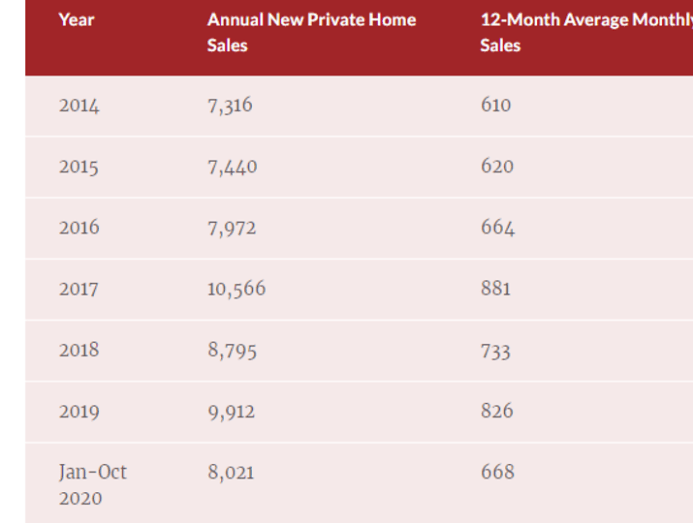
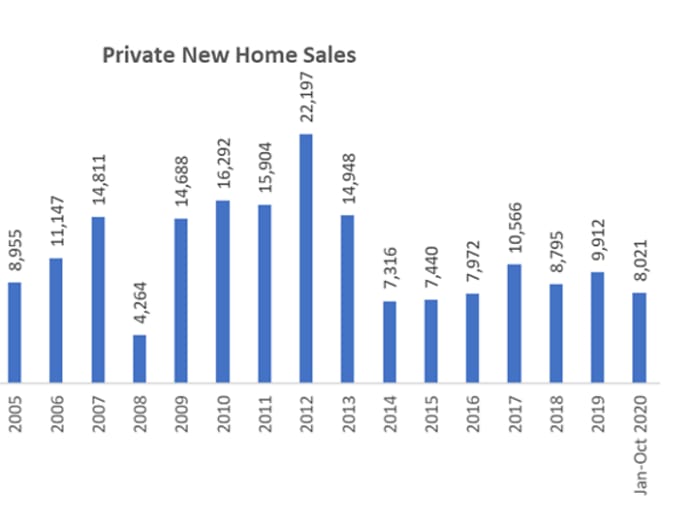
Simply underlying demand for private homes has been strong throughout the pandemic, driven by local buyers and HDB upgraders.
Habitation sales rebounded in the second quarter of 2020, afterwards the terminate of the circuit billow imposed from April 7 to Jun 1. Of note, about 80 per cent of new private homes sold in the offset ix months of 2022 were bought by Singaporeans – representing the highest proportion since 2010, according to Realis data.
During the circuit breaker, consumers became more comfortable with digital property marketing and virtual viewings. They also probably had more than time to evaluate their real manor portfolio and investment plans.
Knowing that the market place has turned in favour of buyers – coupled with the low interest rate environment and ample liquidity in the market – many consumers with set funds made their property purchases between July and September.
READ: Commentary: How much should young couples spend on their showtime home?
PROPERTY MARKET ON FIRMER Basis
That the property market remains resilient despite COVID-nineteen and Singapore's worst recession on tape did not happen by chance.
The series of cooling measures rolled out in previous years placed the holding market place on firmer footing, heading into this crisis. They led to limited speculative action, households purchasing homes prudently and dwelling prices moving more in line with economic and income growth.
The belongings market today is stable and should run into sustainable growth. This was not the example in past crises where the holding market seemed to become through a nail-bosom cycle.

When the dot-com bubble flare-up in 2001, Singapore recorded a full-twelvemonth Gross domestic product contraction of one.1 per cent and the private property cost index plunged 11.7 per cent that yr.
In 2003, when SARS hit Singapore, private home prices posted a 2.one per cent decline for the full yr, before recovering in 2004.
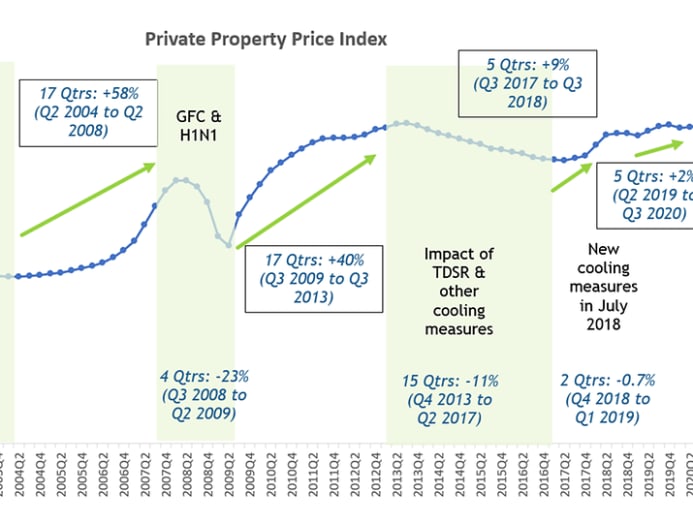
What followed was 17 quarters of growth where prices increased by 58 per cent from Q2 2004 to Q2 2008.
READ: Commentary: Why Singapore's private residential market will remain bonny in the long term
The cost growth footing to a halt following the global fiscal crisis, which saw dwelling values fall by 23 per cent from Q3 2008 to Q2 2009.
Then came another wave of price increase over 17 quarters from the second one-half of 2009 to Q3 2022 where values jumped past twoscore per cent. This was also the flow where a flurry of cooling measures was introduced.
After the June 2022 measures were in place, property prices began to motility in a more than orderly manner. Following a couple of quarters of sharper price ascension in 2018, fresh cooling measures were introduced in July 2018.
READ: Commentary: Who's ownership private property after last year's cooling measures?
STABLE PRICES AND A RESILIENT MARKET
All in all, the Government – which has said it will continue to sentinel the market closely – has successfully engineered a soft landing in the property market, ensuring that prices do non run abroad from economic fundamentals.
The huge stimulus – almost Southward$100 billion – that the Regime has committed every bit part of its COVID-19 response has besides helped to save jobs and support the housing market place.
This war chest is substantially bigger than the South$230 meg SARS Relief Packet announced in April 2003, and the South$20.v billion Resilience Parcel put forth in January 2009 in the wake of the global financial crunch.
READ: Commentary: Winds in the Singapore economy sails are starting to stir
For home owners and investors, the various cooling measures – full debt servicing ratio, additional heir-apparent's postage duty, seller's stamp duty, lowered loan-to-value ratio – will help them brand more than prudent holding buying decisions.
Being less leveraged on property purchase, households should have better belongings power when the going gets tough, mitigating distressed sales.
These curbs have too helped to eliminate speculation in properties, leading to more than stable prices and a more resilient market.
Mind: COVID-19 and the outlook for Singapore's residential belongings market place in 2022 and beyond
CONSIDERATIONS WHEN BUYING PROPERTY
Despite uncertainties alee caused by the pandemic, the outlook for the property market remains positive over the mid- to long-term, because Singapore's fundamentals – safety, political stability, a competitive and pro-business environment – are all the same intact.
In evaluating belongings investment, buyers should focus instead on ii chief areas: Affordability, and thorough financial planning to ensure they can hold on to the holding for at least 5 years.
Ideally, buyers should have a fiscal safety cyberspace of 12 months' worth of mortgage payment set bated (either in cash or in the CPF) to tide them through whatsoever unforeseen events, such every bit job loss.
READ: Commentary: Worried nearly keeping your task? Hither'south advice to soothe your concerns no thing how old you are
Even if a buyer is purchasing a domicile for his or her own stay, it is still important to consider the property'due south capital appreciation potential, in ensuring 1'southward retirement adequacy in the time to come.
A property buy is a significant financial commitment. Buyers should be clear-headed virtually their fiscal ability, housing needs and investment objectives, and be less caught upwardly with emotions roused by news headlines or the fear of missing out.
Ismail Gafoor is CEO of PropNex.
Listen to Ismail Gafoor discuss developments in the property market place since COVID-19 hit on the Heart of the Thing podcast:
Source: https://cnalifestyle.channelnewsasia.com/commentary/commentary-concerned-about-what-fall-private-home-sales-mean-market-fundamentals-paint-different-story-282451
0 Response to "Commentary: Concerned about what fall in private home sales mean? Market fundamentals paint a different story"
Post a Comment